Saturday, September 19, 2015

Doubling and electrification of Vijayawada - Bhimavaram - Nidadavole & Bhimavaram - Narsapur railway lines


Project:


Doubling and electrification of Vijayawada - Bhimavaram - Nidadavole & Bhimavaram - Narsapur railway lines.


Details:


It is making of a new Railway line almost parallel to the existing line including electrification of the existing line & proposed line. This work is a 1433 crore project for a total length of 221 Kms. It involves Execution of about 20 lakh Cum of Earth work, about 20 Lakh Cum of Blanketing, Execution of 28 Major Bridges, 715 Nos of minor bridges, 51 station buildings, construction of 304 nos of staff quarters, development of station yards, platforms, shelters etc. The work also involves acquisition of about 50 acres of land.

Package–1: Construction of Roadbed, Major and Minor Bridges, Track Linking (Excluding supply of Rails and PSC sleepers), General Electrical, Traction and Signal & Telecommunication works (Outdoor) in connection with Doubling with Railway Electrification of Vijayawada - Bhimavaram Section From Km.0.00 to 51.50 between Vijayawada and Moturu Stations (Including Gudivada & Moturu yards) on Vijayawada division of South Central Railway.

Package–2: Construction of Roadbed, Major and Minor Bridges, Track Linking (Excluding supply of Rails and PSC sleepers), General Electrical, Traction and Signal & Telecommunication works (Outdoor) in connection with Doubling with Railway Electrification of Gudivada –Bhimavaram Section From Km.51.50 to Km.105.00 between Moturu & Bhimavaram Town stations (Excluding Moturu & Bhimavarm Town yards) on Vijayawada division of South Central Railway.

Package–3: Construction of Roadbed, Major and Minor Bridges, Track Linking (Excluding supply of Rails and PSC sleepers), General Electrical, Traction and Signal & Telecommunication works (Outdoor) in connection with Doubling with Railway Electrification of Gudivada – Nidadavole Section From Km.105.00 to 154.75 between Bhimavaram Town and Nidadavole Stations (Including Bhimavarm Town, Bhimavaram Junction & Nidadavole Junction yards) on Vijayawada division of South Central Railway.

Benefits:


Acts as supplement for Vijayawada - Vishakapatnam main railway line  which is already being excessively utilized. Eases the traffic and allows to operate additional Passenger/Freight trains.


Boost  to Economy - This project benefits regional areas in a big way. Bhimavaram region tops in producing Aqua products in the country,  Palakole region is famous for its Coconut products and Narsapur region is famous for its Lace products and Tanuku region produces Sugarcane. Also this regions is often referred as "Rice bowl of India". 

Completion of this project helps all these regions to export their products to new markets with cheaper transportation charges.

Project Status:


Date
Activity
2011-12
1. Union Ministry of Railways sanctioned the project as part of Union budget 2011-12
2. It's a joint venture between Rail Vikas Nigma Limited (RVNL) and State Govt of Andhra Pradesh.
3. RVNL & State Govt of A.P shares 50% of total cost each.
April 2013
Minister of State for Railways Kotla Suryaprakash Reddy had laid foundation stone for the first project
May 2013
RVNL issued 120 crores INR for this project (out of 570 crores of its share)
May 2015
State Govt of A.P sanctioned 120 crores INR
Feb 2016
75 crores INR allotted in 2016-17 railway budget


Here is Youtube link (external source)  https://www.youtube.com/watch?v=P56Tf8678d4

Tuesday, September 8, 2015

Mega Aqua Food Park in Bhimavaram


Mega Aqua Food Park in Bhimavaram:


Aimed at encouraging the food-processing sector, the union government had in August last year approved a proposal to set up 12 mega food parks across the country during the 12th five-year plan period that ends in March 2017 involving an allocation of over Rs 1,700 crore.

Director of Godavari Mega Aqua Food Park, U. Jogi Anand Varma, said the company expects to attract at least 30 fish and prawn processing units to come up in their food park where they are investing around Rs 120 crore on the physical infrastructure. "Bhimavaram is an ideal location for setting up units for value-added aqua products for both domestic and export markets. We expect these 30 processing units to invest around Rs 800 crore over the next 18-24 months."

Andhra Pradesh's principal secretary for food processing JSV Prasad said that the proposed Aqua food park is expected to be ready by end of 2015.

Godavari Mega Aqua Food Park Private Limited - Company Details:  


Godavari Mega Aqua Food Park Private Limited is a Private Company incorporated on 19 December 2012. It is classified as Indian Non-Government Company and is registered at Registrar of Companies, Hyderabad. Its authorized share capital is Rs. 275,000,000 and its paid up capital is Rs. 50,000,000.It is involved in Agricultural and animal husbandry service activities, except veterinary activities.[This class includes specialized activities, on a fee or contract basis, mostly performed on the farm.]

Godavari Mega Aqua Food Park Private Limited's Annual General Meeting (AGM) was last held on 15 May 2014 and as per records from Ministry of Corporate Affairs (MCA), its balance sheet was last filed on 31 March 2014.

Directors of Godavari Mega Aqua Food Park Private Limited are Cheruku Vada Sri Ranga Nadha Raju, Uddaraju Krishna Prasad, Ananda Kiran Uddaraju, Srilaxmi Devi Uddaraju and Niraj Kumar Gayagi.

Godavari Mega Aqua Food Park Private Limited's Corporate Identification Number is (CIN) U01403AP2012PTC084927 and its registration number is 84927. Its Email address is anandagroup@gmail.com and its registered address is 27-01-5/2 , Backside of Blue Star, J.P. Road,, Bhimavaram - 534202, Andhra Pradesh INDIA. Current status of Godavari Mega Aqua Food Park Private Limited is - Active.


Aqua University in Bhimavaram

*** Article from Eeenadu Daily News Paper 09th September 2015 edition ***

Aqua University in Bhimavaram:


Defective seed supplied by some of the unauthorised hatcheries is posing a serious threat to the culture of vannamei shrimp in Andhra Pradesh, and it is imperative that the State Government take the requisite steps for supply of quality seed, according to many aqua farmers who participated in the Aqua Aquaria 2015.

Most of the farmers' representatives, including K. Narayana, Member of Parliament from Machilipatnam and himself an aqua farmer, said as there were no quarantive facilities in the State the brood stock was being imported from the USA through Chennai port. Therefore, on a priority basis, quarantine facilities should be set up and also brood stock multiplication centres for supply of quality seed. Otherwise, they said, vannamei shrimp culture would face the same problems as the monodon (tiger shrimp) faced some years ago in the State.
The farmers also said the applications for digging new aqua ponds were not being cleared speedily and there were too many procedural hassles. They should be addressed. 

The seafood industry representatives wanted fisheries colleges and also a university in the State, as there was a huge dearth of skilled personnel in the sector. Uddaraju Ananda Raju (UAR) Foundation of Ananda Group of Companies is planning to start the AP Fisheries and Ocean University in West Godavari district soon. The new university, proposed under Public-Private-Partnership (PPP) would be constructed in about 150 acres. Asian Institute of Technology (AIT), an international institute of higher learning in Bangkok, has agreed to transfer the technology and help in establishing Andhra Pradesh Fisheries and Ocean University.


Saturday, August 22, 2015

Why Andhra Pradesh needs Special Category Status..?

*** Information in this post is extracted from "Teaching and Research Associate, Gujarat National Law University, Gandhinagar" and http://planningcommission.gov.in/ website. ***

What is "Special Category Status" means..??

The decision to grant special category status to States lie with the National Development Council composed of the Prime Minister, Union Ministers, Chief Ministers and members of the Planning Commission, who guide and review the working of the Planning Commission. Initially, three states namely Assam, Nagaland and Jammu & Kashmir were accorded special category status and later on eight other states were also given special category status namely: Arunachal Pradesh, Manipur, Meghalaya, Mizoram, Uttarakhand, Tripura, Himachal Pradesh, and Sikkim and thus the list is now increased to eleven. 

The bases on the basis of which NDC decides whether a State should be accorded special status or not includes: hilly and difficult terrain; low population density and or sizeable share of tribal population; strategic location along borders with neighboring countries; economic and infrastructure backwardness and non-viable nature of state finances. At the time of resource allocation by the centre to States, these special category States are at a beneficial position. After the Report of Fifth Finance Commission, a formula was fixed for the distribution of resources between the states. This formula was named after the then deputy Chairman of Planning Commission Dr. Gadgil Mukherjee. 

The Gadgil-Mukherjee Formula adopted by consensus in 1991 was made the basis for the distribution of tax revenue and grants during 8th Five Year Plan (1992-97) and has since been in use. Among states, the distribution of tax revenue and grants is determined through the formula accounting for population (25%), area (10%), fiscal capacity (47.5%) and fiscal discipline (17.5%). The Finance Commission and the Planning Commission are bodies entrusted with the work of transferring the resources from the Centre to the States. 

The Planning Commission allocates funds to states through central assistance for state plans. Central assistance can be broadly split into three components: Normal Central Assistance (NCA), Additional Central Assistance (ACA) and Special Central Assistance. Normal Central Assistance favours special category states and they get 30% of the total assistance while the other states share the remaining 70%. NCA is in the form of 90% as grants and 10% loans for special category states, while the ratio between grants and loans is 30:70 for other states. There is no fixed formula for Special Central Assistance and it depends on the basis of the state’s plan size and previous plan expenditures. Besides this, special category states enjoy concessions in excise and customs duties, income tax rates and corporate tax rates as determined by the government. 

The Planning Commission also allocates funds for ACA for the purpose of assistance for externally aided projects and other specific project. The Finance Commission is entrusted with the work of distribution of central tax revenues among states. The Finance Commission also recommends the principles governing non-plan grants and loans to states. In order to achieve the status of a special category state, a state has to project itself as socioeconomically or strategically vulnerable state however it is ironical that a number of states are demanding their names to be included in the list of special category states in order to exploit the numerous benefits conferred to states which are accorded this special status by NDC. 

Distribution of Central Plan Assistance: General and Special Category States


A major change happened when in the dispensation of plan assistance, plan loans were delinked from plan grants after the recommendations of the Twelfth Finance Commission. Since the implementation of delinking of plan loans from plan grants, a review of criteria on the basis of which grants are distribute across states has also become more relevant because the principles on which loans should be given and the principles on which grants should be given are entirely different. In particular, loans can be given based on capacity to utilize and service the loans efficiently while grants should be given based on needs.

Finance Commission Criteria and Plan Grant Criteria

One of the terms of reference to this Working Group has asked us to examine the case for adopting the Finance Commission resource allocation formula for the inter se allocation of plan grants. There is a major difference in the objectives that guide the formulation of resource transfers undertaken by the Finance commission and that by the Planning Commission although there is also a clear inter-connection between the two streams of resource transfer. In the case of Finance Commission, the objective is to make allocations such that fiscal capacities are equalized with a view to enabling the states to provide public services and merit services at equal standards to all citizens in the state provided that comparable tax effort is made by the states. In other words, differences in the service standards should be due largely to deficiency in own tax effort and not due to deficiency in fiscal capacity. In determining the interse shares, at any point of time fiscal capacity is taken to be given. Plan grants in combination with borrowed resources aim at the developmental effort of the state. The objective is to change the fiscal capacity itself. Plan grants therefore must aim at reducing the differences in fiscal capacity: larger transfers should be given to states with lower development levels. Since per capita incomes is generally taken as summary indicator of the level of development, it should be the main determinant in the case of plan grants: lower the per capita income higher the transfer. However, deficiency in development effort should not be rewarded. 

Gadgil-Mukherjee Formula: 

A Review The Planning Commission used to provide developmental grants to states as part of an overall assistance package. This package was determined as a composite of loans and grants. The relative ratios of loans and grants were different for the special category states as compared to the general category. For the general category states, assistance was 30 percent grant and 70 percent loan. For the special category states, 90 percent of assistance was given as grant and 10 percent as loan. The expenditure side of state budgets may be divided into four parts: non-plan revenue expenditure, plan revenue expenditure, plan capital expenditure, 26 and non-plan capital expenditure. The first and second components combined to give the revenue account of a state, which pertains to recurrent (revenue) expenditures. Plan assistance was meant for the second and third components taken together. In the initial stages, when plan assistance was conceived of in terms of an overall package, the expectation was that nearly 30 percent of the plan would actually be in the nature of recurrent expenditures and 70 percent would pertain to capital expenditures. In accordance with such an expectation, the grant to loan ratio in plan assistance was fixed as 30 and 70 percent of total plan assistance. It was expected that all capital expenditures would be met by borrowing and by surpluses on revenue account. As such no capital grants were envisaged for the general category of states in plan assistance. The position of the special category states was different in the sense that from the 90 percent that they were getting as grant, 30 percent could be allocated for the revenue component of the plan, and the balance of 60 percent could then emerge as a capital grant. In practice however the relative claim of recurrent expenditure continued to increase and has become on an average 60 percent of plan outlay in the case of general category states. Borrowing thus basically finances capital expenditure, in the general category states. In fact, it is not only that there are no capital grants, but also that a substantive part of current expenditures are also being financed by borrowing. The overall dispensation of (normal) plan assistance can be summarised according to special and General category states, and according to grants and loans as indicated in below table. Two other channels of plan assistance are additional central assistance (ACA) and external assistance. Both were given on the same terms and conditions as normal plan assistance prior to a change in the terms and conditions for transmission of external assistance. After the recommendations of the Twelfth Finance Commission, external assistance is passed on to the states, as additional central assistance on back to back basis that is, on the same terms and conditions as the original external assistance.


The Planning Commission allocates aggregate (normal) plan assistance among states under a set of criteria called the Gadgil-Mukherjee Formula. The original formula has been subjected to changes from time to time and the present version is referred to as the National Development Council (NDC) revised Gadgil-Mukherjee Formula. As noted, the GadgilMukherjee Formula works in two stages. First, 30 percent of total assistance money is earmarked for the special category states. This may be distributed among these states on the basis of their plan size and past plan expenditures, without using any explicit criteria. The remaining 70 percent are distributed among the general category states according to a set of criteria with relative weights. These criteria have been summarised in Table 4.2. A comparison can also be made between the alternative versions of the formula, as it has changed over time. The Planning Commission does not publish the actual shares of states either criteria-specific or aggregate as is done by the FC. The shares may change under each criterion, as more recent data on income, tax effort, etc., become available. However, as far as population is concerned, only 1971 population is used.


Notes: 1. Fiscal management is assessed as the difference between states’ own total plan resources estimated at the time of finalising Annual Plans and their actual performance, considering latest five years. 2. Under the criterion of the performance in respect of certain programmes of national priorities the approved formula covers four objectives, viz.: (i) population control; (ii) elimination of illiteracy; (iii) on-time completion of externally aided projects; and (iv) success in land reforms. 

The important elements in this formula relate to factors of population, deviation of income from mean income, distance of income from highest income, and other factors reflecting fiscal discipline and achievement of national objectives. Due to the very high weight given to the population factor, which allocates equal per capita shares to all states, dispensations under the Gadgil Formula are only mildly progressive. When the original Gadgil Formula for the distribution of central assistance for State Plans was approved by the National Development Council in September 1968, it was agreed that the requirements of Assam, Jammu & Kashmir and Nagaland should first be met out of the total pool of central assistance. For the three annual plans immediately preceding the application of Gadgil Formula, the share of Assam, Jammu & Kashmir, and Nagaland in total plan assistance was 9.26 percent. For the Fourth Plan (1969-74) when the Gadgil Formula was first applied, an amount was earmarked for these three states, but their share averaged to a little above 11 percent. For the Fifth Plan, the share of these states was a little 15 percent. For two annual plans (1978-80), the share of these states became a little more than 16 percent. When the Fifth Plan was formulated, this list was extended to include Himachal Pradesh, Manipur, Meghalaya, Sikkim and Tripura, making eight states in all. It is only since 1980 that the share of Special Category states was predetermined at 30 percent. In 1990, the number of special category states was increased to 10 with the inclusion of Arunachal Pradesh and Mizoram. 

The main weaknesses in the application of the Gadgil-Mukhjerjee Formula in its various mutations are summarised below: 
i. There is no explicit basis for a 30 percent earmarking for the Special Category states. 
ii. Shares determined on the basis of tax effort and fiscal discipline indexes are unscaled implying that if a large state like Maharashtra and a small state like Goa had the same tax effort ratio, they will get the same share regardless of their size. This would lead to a very large per capita share for Goa compared to that for Maharashtra, for example, for the same tax effort. 
iii. The link between plan schemes/projects and plan assistance has been lost, leading to a severing of a link between costs and benefits, and lack of effective project based monitoring; and 
iv. The 30:70 grant to loan ratio has long become irrelevant if the 30 percent grant ratio was meant to cover revenue expenditure on plans. 
v. There are no objective criteria for the distribution of 30 percent earmarked share among the special category states.

Why Andhra Pradesh Needs Special Category Status..?

Will continue in my next post..!!

Monday, May 25, 2015

Amaravathi - Andhra Pradesh's New Captial

*** This is an article published in Eenadu Telugu Daily new Paper / Dt: 26th May 2015 ***
*** http://www.eenadu.net/Homeinner.aspx?item=break166 ***


Saturday, November 22, 2014

Bhimavaram

Introduction:


Bhimavaram At Glance - Pictures in clockwise direction
Mavullama deity, Someswara Swamy deity, Someswara swamy temple, Lush paddy fields,
Bull race, Rooster fights
(Pics courtesy -  https://www.facebook.com/Bhimavaramthebranded)

Bhimavaram is a City governed by its Municipal corporation which comes under Bhimavaram Metropolitan Region in West Godavari district of the state of Andhra Pradesh, India.  As per provisional reports of Census India, Bhimavaram Metropolitan comprising Bhimavaram city, Rayalam and Chinamiram villages.

Bhimavaram is also called as "Second Bardoli of India". Mahatma Gandhi coined the name when he was visited the city during the freedom movement in India.

It is also one of the sacred “Pancharama Kshetras” called as “Somaramam”. Bhimavaram “Mavullamma Ammavari” temple is a very famous temple and one of the  richest temple in Andhra Pradesh.

It is the capital of Aqua culture in the state of Andhra Pradesh and is very well known for its Prawn culture. It also received Town of excellence awards from Central government of India for its significant  contributions towards Nation's foreign revenue.

It is also one of the important trade center for Paddy in the state of Andhra Pradesh.

Bhimavaram city is economically well advanced and per capita income is more than the State and Nation's average. Bhimavaram has been recognized as "Towns of Export Excellence - 2015"  under seafood category and one among the 33 towns in the country. It also nominated for AMRUT (Atal Mission for Rejuvenation and Urban Transformation) project taken over by Central government of India. It is also a regional hub for Higher Education, Specialized Health services, Commerce, Shopping and Entertainment in the West Godavari district. It is also famous for its Traditional fares, Rooster(Cock) fights, Bull races and Gambling during Sankarnti festive season and hence the city is often referred as 'Los Vegas of A.P.'.

History:


Bhimavaram was controlled by the Chola Empire. Under Kulothunga Chola I, Bhimavaram was ruled by his sons who served as viceroys. Various stone inscriptions have been found in the city dating from his reign (c. 1096 C.E.).

It was said that Chalukya Bheema from Eastern Chalukya dynesty laid foundation and constructed a Siva temple that is present Gunupudi Siva temple Somaramam in the year 890-810 A.D. It is one among the five Siva temples called as Pancharamas.

Bhimavaram was the site of several protests during the Salt Satyagraha Movement. It played a major role in the freedom movement, during the rule of British empire in India. The taluka office in the Bhimavaram is a witness of freedom movement since 1887.

To support Non-Cooperation movement all sectors of people like Teachers, Lawyers, administrative staff who were working for British empire pen down their services and also stopped paying taxes. After knowing this Mr.Gandhi praised Bhimavaram as the "Second Bardoli" in his journal "Harijan".

Mahatma Gandhi was very much moved after seeing the generosity  of the people during his visit to the city in the year 1932. People were religiously donating their fortunes to "Independence fund (Tilak Nidhi)" to support Freedom movement. Mahatma then praised Bhimavaram as the land of "Supreme Sacrifice". During Quit India movement on August 17, 1942 Police opened fire to control the protestors at Taluka office, where few people were killed.

Historical places:


Somaramam (Pancharama Kshetram) Temple:

Shiv ling appearing white on a full moon day
(Pics courtesy -  https://www.facebook.com/Bhimavaramthebranded)
This temple was Built during the 3rd century A.D. Here Lord Shiva is known as Uma Someswara Swamy. The consort of Lord Uma Someswara Swamy is Sri Rajarajeswari Ammavaru. 

The Sivalinga at this place is established by Lord Chandra (Moon God). Since it was built by Lord Chandra, Shivaling here will change its colour according to Lunar aspect. At the time of Pournami (Full Moon day) Shivaling will be in white colour and gradually loses its colour and turns into black by Amavasya (No moon day). 

Another unique thing here, is that the temple of Goddess Annapurna was built on top of the Shiva temple, something that cannot be seen anywhere in the country.

Mavullamma Temple:


Sri Mavullama diety
People believe that Mavullamma Ammavaru as the incarnation of Goddess Mahakali. It is believed that, in the year 1880, Goddess told about the place where she emerged to Marella Machiraju, Grandhi Appanna in their dream. They searched  for and found the statue under a Pipal and Neem tree. From then prayers started in a hut constructed around the statue. Later a new temple was constructed at Sunday bazaar (5 Lantharla Sthambam). In 1910, the Goddess statue was partially spoiled due to unexpected floods. In 1920, Sculpter Thathavoolu Naga Bhushanacharyulu  from the village Kaalla modified the statue. Ramakrishna Paramahamsa and Gowthama Budha seated beside Goddess is another special attraction in the temple.

Every year in the month of "Jyesta masa" (third month of auspicious Telugu almanac calendar) on "Paadyami" (new slender crescent moon day),  devotees celebrates festival which goes for nearly a month.

In January 2012, the goddess  was decorated  with a gold saree of 65 kg and ornaments. An estimated amount of 20 crores were collected by “Swarna vastra nidhi”. Goddess have Trisula and Damarukam made of 16 kg gold. And also, having a gold crown.

Jain Temple:


Jain Mandir - Bhimavaram
pic courtesy - facebook.com/bhimavaram.wgdt page

Here the mulyankan is Nearly 118 cms high, black-colored idol of Bhagawan Vimalnath in the Padmasana posture.This is a renovated temple and the antiquity of the idol cannot be guessed. Its artistry reveals that it is more than 1000 years old. While digging the land, this idol was found from the hollow of the ground, nearly 85 years ago. This idol was installed in the new temple under inspiration of Munishri Nandavijayji on the auspicious eighth day of the month of Magh in the year 2021 of the Vikram era. On the fifteenth day of the bright half of the month of Chaitra, a fair is held here every year.

Geography:


Bhimavaram city is located on the junction of Nidadavole – Narasapuram and Vijayawada – Bhimavarm Broad Gauge section of the South Central Railway. It also lies on Kathipudi - Pamarru National High Way NH.214.
It’s location on the Geographical sphere is at latitude 16.54 North and longitude 81.52 East

Climate:


Bhimavaram is located on the coastal belt and falls within the hot humid region of the country. The climate of this region is generally hot in summer with 45oC maximum and 18oC as minimum in the year. The average rain fall records to 100cm. The air is humid throughout the year ranges from 45% to 55% in the afternoon. Storm and depressions originates in the Bay of Bengal during the post monsoon season.

Demography: 


Bhimavaram city has become an important commercial center especially due to exponential growth in Aqua culture in late 90's. Since then its started attracting people form its surrounding villages to migrate. This trend is mainly due to better employment opportunities, better education facilities and health care facilities and as some critical state and central government offices are situated in the town. 


Census  - 2011 Statistics:

The following table shows the population growth over the decades in Bhimavaram:


The following table shows detail population statistics of Bhimavaram:


The following table shows the Ethnic groups and Religion-wise statistics of Bhimavaram:


The following table shows some figures and facts about Bhimavaram City at a glance.
Note: Some of the below information might be not up to date (2012 year data)


Administration and Politics


Bhimavaram Municipality:


Bhimavaram municipality was constituted in the year 1948 as third grade Municipality and up graded as Selection Grade in the year 2011.

The following table shows the progress of the Municipality over the period of time.


Bhimavaram Assembly constituency:


Below are the Bhimavaram Constituency details:


Elected members of Bhimavaram Assembly Constituency since 1952:


Narasapuram (Bhimavaram ) Parliament constituency:


Elected members of Narasapuram Parliament Constituency since 1957. Bhimavaram Assembly constituency falls under Narsapuram Parliament constituency.


Bhimavaram Mandal


The following are village and Panchayats in the Bhimavaram mandal.
  • Anakoderu (village and panchayat)
  • Annavaram (village and panchayat)
  • Bethapudi (village and panchayat)
  • Chinaamiram village and panchayat)
  • Deyyalatippa (village and panchayat)
  • Dirusumarru (village and panchayat)
  • Dongapindi (village and panchayat)
  • Gollavanitippa (village and panchayat)
  • Goraganamudi (village and panchayat)
  • Gutlapadu (village and panchayat)
  • Jonnalagaruvu (village and panchayat)
  • Komarada (village and panchayat)
  • Komatitippa (village and panchayat)
  • Kothapusalamarru (village and panchayat)
  • Losari (village and panchayat)
  • L.V.N. Puram (village and panchayat)
  • Nagidipalem (village and panchayat)
  • Narasimhapuram (village and panchayat)
  • Pedagaruvu (village and panchayat)
  • Pennada (village and panchayat)
  • Rayalam (village and panchayat)
  • Sriramapuram (Gunduvari Pet) (village and panchayat)
  • Srungavruksham(village and major panchayat)
  • Taderu (village and panchayat)
  • Thokatippa (village and panchayat)
  • Tundurru (village and panchayat)
  • Vempa (village and panchayat)
  • Yenamadurru (village and panchayat)

Bhimavaram municipality wards


Famous Personalities:


Famous Personalities from Bhimavaram and nearby villages:


Sri Alluri Sita Rama Raju - Freedom fighter


Sri Adivi Bapi Raju - Poet


Sri Dantuluri Narayana Raju - Educationalist


Sri Dr. Y. Subba Rao - Medical Science

Education:


Primary/High School and Junior College education:

In Bhimavaram the education system is of 10+2 system before joining under Graduation. First standard to Tenth standard classes are conducted by the School Education under the administration of the School Education Department, Andhra Pradesh and finally the Tenth Class (S.S.C.) Public examination at state level is conducted by the Board of Secondary Education, Andhra Pradesh. After this, two years of Intermediate Education under the administration of the Board of Intermediate Education, Andhra Pradesh.

Below are the list of High schools governed by Bhimavaram Municipality.
  • A.R.K.R.Municipal High School
  • Chinaranganipalem Municipal High School
  • J.L.B. Municipal Girls High School
  • P.S.M. Municipal Girls High School
  • Padmabhushan Dr B.V.Raju Municipal High School
  • S.U.S. Municipal High School
Below are the list of some of the High schools under Private sector.
  • Abhyas Global School
  • West Berry Global School
  • St. Marrys High school
  • Viswakavi High School
  • Bharatiya Vidya Bhavans School
  • Gowtham Modern school
  • Bhashyam School
  • Vishnu School
Below are the list of Junior Colleges under Government sector.
  • Kasturiba Junior college
  • R.R.D.S Junior college
Below are the list of prominent Junior Colleges under Private sector.
  • Aditya Junior College
  • Sri Chaitanya Junior College
  • Narayana Junior College
  • Nalanda Junior College

Higher Education:


After completing 10+2 education, students enrol in colleges with a higher education facility. Admission to professional graduation colleges in Bhimavaram, many of which are affiliated with either Andhra University or Jawaharlal Nehru Technological University (JNTU), is through the Engineering Agricultural and Medical Common Entrance Test (EAM-CET).

Below are the list of some of the colleges offering higher education studies mentioned above
  • Dantuluri Narayana Rao (D.N.R) Educational Institutions
    • D.N.R Degree college
    • D.N.R P.G College
    • D.N.R College of Law
    • D.N.R College of Education
    • D.N.R College of Engineering and Technology
  • Vishnu Educational Society
    • Sri Vishnu College of Engineering for Women
    • Sri Vishnu Institute of Technology
    • Sri Vishnu Dental College
    • Sri Vishnu College of Pharmacy
    • Padmasri Dr. B.V.Raju Institute of Computer Education
  • K.G.R.L College (Degree and P.G. Courses)
  • Dr C.S.N College (Degree and P.G. Courses)
  • S.R.K.R Engineering College
  • Bhimavaram Institute of Technology
  • Chaitanya Engineering College
  • Grandhi Varalakshmi Venkatarao Institute of Technology
  • Mentey Padmanabham College of Engineering and Technology
  • Sri Vatsavai Krishnam Raju College of Engineering and Technology
D.N.R Education Institutes


S.R.K.R Engineering College


Vishnu Education Institutes


Vishnu Education Institutes


West Berry Global School

Economy:


The Bhimavaram city is located in the middle of the Godavari Delta region and is Agro & Aqua based economy. It is one of the important trade centre of Paddy in Andhra Pradesh. The Agro base industries like food processing, Prawn Culture, Rice Mills etc., are the main industries. The city serves as distribution center as well as commercial center, to its hinterland. The city becomes the regional center for higher education and specialized health services.

Bhimavaram has been recognized as "Towns of Export Excellence"  under seafood category and one among the 33 towns in the country. Total estimated exports are worth more than INR 10000 crores.

Bhimavaram Municipality - Budget


Bhimavaram Municipality Budget 2012-13 - High Level Summary:


Bhimavaram Municipality Budget 2012-13 - Income Details:


Bhimavaram Municipality Budget 2012-13 - Expenses Details:


Bhimavaram Constituency Productivity Details:


Industries


  • Delta Paper Mills
  • Agro Industries
  • Marine Industries
  • Marine Products Export Development Authority (MPEDA)
  • MPEDA - E.U. Approved Marine Plants
    • Ananda Foods
    • Jagadeesh Marine Exports
    • R V R Marine Products Ltd
    • R D R Exports
    • R D R Exports Unit 2
    • Sandya Marines Ltd
    • Sandhya Marine Ltd Unit 2
    • Blue Park Sea Foods
    • Uniloids BioScience Private Limited
    • Hari Priya Marine Exports Private Limited
    • Universal Cold Storage Limited
    • Suryamitra Exim Private Limited
    • Asvini Fisheries Private Limited
    • Jayalakshmi Seafoods Pvt Ltd (Unit-II)
    • Wellcome Fisheries Ltd
    • Kader Exports Pvt Ltd
    • Food Processing Units
  • Poultry
  • Real Estates
  • Bhimavaram Agricultural Market yard
  • Krushi Vignyana Kendram


Ananda Group of companies - Marine Processing Plant


Jagadish Group of Companies - Marine Processing Plant

NetEnrcih - U.S California based Software development company


Health Care:

Some of the best hospitals in the State are situated in Bhimavaram and providing advanced healthcare services.
  
MGMCRI (Mahatma Gandhi Memorial Cancer Research Institute) is conducting state of the art research institution on Cancer related studies. Bhimavaram hospitals & Varma hospitals are well known hospitals under private sector. Dr. M R Raju who is the founder of this institution is an internationally known scientist in the area of radiation and cancer. He has published more than 125 research papers and is the author of the book "Heavy Particle radiotherapy" published by the Academic Press.

Government hospital, Bhimavaram hospitals and Varma hospitals are other institutes offering high quality healthcare services.(General Medicine, General Surgery & Gastroenterology, Cardiology, Urology, Nephrology, Neurosurgery, Gynecology and obstetrics, Pediatrics & Neonatalogy, Orthopedics, Radiology, ENT, Dermatology, Physiotherapy, Pathology, Psychiatry General and Endoscopic Surgery, Microbiology and Biochemistry)


Mahatma Gandhi Memorial Cancer Research Institute


Bhimavaram Hospitals

Sports


Since 2012, every year Cosmopolitan club conducts ITF (International Tennis Federation) Futures tournament involving players from all over the world. This year (March’ 2015) there were 25 players from United Kingdom, Germany, Italy, Spain, Chinese Taipei, Japan, Zimbabwe, Uzbekistan, Kazakhstan, and Sri Lanka were part of the tournament along with 35 Indians. Apart from prize money (10000 - 15000 USD$) players take part in this ITF tournaments to earn ATP points and to increase their rankings. Matches were live telecasted in Doordarshan. Cosmopolitan Club management contemplating sprucing up of another tennis court and both Youth Club, DNR College evincing interest to lay a couple of courts; Bhimavaram will soon transform into a fully-equipped tennis centre with seven courts.

Tourism


Bhimavaram has a range of tourist attractions including Sacred Temples, Local traditional exhibition fares, Landscapes with lush green Paddy fields, Lakes and Canals, Sankranti festival, Beaches, Resorts near to Godavari river, Wildlife sanctuaries and many others within a 50-kilometre radius of the city. City is also having some nice Three-star hotel facilities (The Ananda Inn and Falcon nest)

Pancharama Kshetram (Somaramam)

Maha Shiva Ratri Utsavam:


Sri Someswara Swamy - Radhotsavam

Sri Mavullama Ammavari Temple

Mavullama Jatara:

Every year in the month of "Jyesta masa" (third month of auspicious Telugu almanac calendar) on "Paadyami" (new slender crescent moon day), devotees celebrates festival which goes for nearly a month.

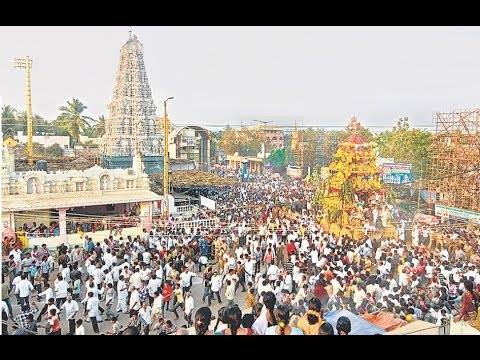
This is one of the largest spiritual event in the state of Andhra Pradesh and devotees from all over the state will come here to go under the spell of festive spirit during the month-long celebrations. During this time, entire temple and its surrounding areas will be decorated in a fabulous way which spreads the festive spirit of Sankaranti all over the town. Every year before the start of festival entire temple including deity will be colour coated and all the Ornaments of deity will be polished. All the major roads near the temple will be covered with shades (Chaluva Pandillu) and are decorated with flowers and illuminated with electrical lights. Huge cinematic sets representing different Hindu mythological events and other contemporary political events are other attractions here.

Every year, The festival committee along with Neerulli Fruits & Vegetable market association organizes spiritual activities such as Harikathalu, Burrakathalu, Purana Pathanam, Veda pathanam and Bhagavadgeeta pathanam. Also often they arrange some cine cultural activities for the entertainment of the people.

The festival will conclude with ‘Anna danam’ to over 75,000+ people on the last day of the event.


Temple surroundings during Jatara
(Pics courtesy -  https://www.facebook.com/Bhimavaramthebranded)


Temple surroundings during Jatara
(Pics courtesy -  https://www.facebook.com/Bhimavaramthebranded)


Temple surroundings during Jatara
(Pics courtesy -  https://www.facebook.com/Bhimavaramthebranded)
Temple surroundings during Jatara
(Pics courtesy -  https://www.facebook.com/Bhimavaramthebranded)


Temple surroundings during Jatara
(Pics courtesy -  https://www.facebook.com/Bhimavaramthebranded)


Temple surroundings during Jatara
(Pics courtesy -  https://www.facebook.com/Bhimavaramthebranded)


Temple surroundings during Jatara
(Pics courtesy -  https://www.facebook.com/Bhimavaramthebranded)

Sankranti Festival


One should visit Bhimavaram during the Sankarnti festive season to experience the true spirit of this Harvest festival. Wherever you go in the town you will experience the positive vibrations of the festive spirit.
Special attractions of Sankranti:
  • Mavullamma ammavari Jatara
  • Kodi Pandalu (Cock fights)
  • Yedla Pandalu (Bull Races)
  • Muggula Potilu (Rangoli)
  • Sampradaya Andala Potilu (Beauty contests – Traditional wear)
  • Food festivals (especially Non vegetarian Items like Fish, Prawns, Meat and Non Veg pickles)
  • Gambling (even though it’s not legal you will findout lot of counters/stalls during the 3 days of Sankranti festive season)
  • Lush green Paddy fields, Canals and Ponds.

Fish Pond 
Pic Courtesy: http://siaphotography.in


Lush paddy fields around Bhimavaram


Fish Pond 
Pic Courtesy: http://siaphotography.in


Lush paddy fields around Bhimavaram


Rooster fights during Sankranti festival - Pic courtesy Abhi


Bull races during Sankranti festival - Pic courtesy Abhi 


Kolleru Lake (Protected wild life sanctuary)


Kolleru Lake is one of the largest freshwater lakes in India. Kolleru is located between Krishna and Godavari delta and near about 30 km from Bhimavaram. The lake serves as a natural flood-balancing reservoir for Krishna and Godavari rivers. The lake is fed directly by water from the seasonal Budameru and Tammileru streams, and is connected to the Krishna and Godavari systems by over 68 in-flowing drains and channels. This lake is a major tourist attraction. Many birds migrates to here in Winter season, such as Siberian crane, Ibis, and Painted storks. This lake is an important habitat for an estimated 20 million residents and thousands of migratory birds, including the Grey or Spot-billed Pelican. The lake was declared as a wildlife sanctuary in November 1999 under India's Wildlife Protection Act of 1972, and designated a wetland of international importance in November 2002 under the international Ramsar Convention. The wildlife sanctuary covers an area of 308 km².


Perupalem Beach


The Perupalem Beach is located at a distance of 25 kilometers from Bhimavaram. The beach is famous for its scenic beauty and the coastline that offers a pleasurable retreat to its visitors. The Perupalem Beach possesses a natural bay. The waters of the beach are shallow and safe for the tourists who approach the beach to wade through it. The 20 kilometers ride to Perupalem Beach offers the visitor a view of the paddy fields and the lined coconut trees that part the fields on both sides of the road. The Venkateswara swamy temple and Baptist Church near the beach are also a tourist attraction. The Perupalem Beach opens itself to the clear blue waters of the Bay of Bengal. The natural beauty of the beach creates an idyllic charm that lures tourist to it.


A.P.Tourism Resorts on the banks of Godavari river


The Andhra Pradesh Tourism Development Corporation (APTDC) offers a two-day and one night package tour that will take you long the winding tributaries of Godavari viz. Vynateyam and Vasista and covers Dindi, Anthervedi and many pilgrim centres like Sri Lakshmi Narsimha Swamy Temple etc. It offers air conditioned houseboats for cruises which are fully furnished with attached bathes, and a sit out-cum-dining area on the deck. The boat will drop anchor at Dindi Resorts (both starting and ending point). From Dindi resorts the cruise will sail upstream from Rajolu Town and to downstream up to Narsapur town. For those who wanted to have a night stay at boat, the boat will be anchored near the resorts Dindi is near about 30 km from Bhimavaram via Palakole.


Entertainment, Hotels & Shopping Malls


Hotels:

  • Falcon Nest Hotel (3 STAR hotel facility)
  • Ananda INN (3 STAR hotel facility)
  • Jaya Lakshmi International

Shopping Centers:

  • Coastal City Center shopping mall
  • Reliance Digital shoppe
  • Reliance Fresh
  • Reliance Trends
  • Spencers
  • Khazana Jewllers
  • Bhimavaram Central shopping mall
  • M&M shopping mall
  • Kalaniketan store

Movie Theaters:

  • Geeta Multiplex(4 Screens)
  • Vijayalakshmi A/C DTS cine complex(2 Screens)
  • Sri Padmalaya A/C DTS cine complex(2 Screens)
  • Annapoorna A/C DTS(7.1)
  • Venkatrama DTS
  • Natraj A/C DTS
  • kishore 70 MM A/C DTS (2 Screens)

  • Coastal City Center Shopping mall
    Coastal City Center Shopping mall
Geetha Multiplex - Movie theater
(pic courtesy - https://www.facebook.com/Bhimavaramthebranded )
Falcon Nest - 3 Star hotel facility
Reliance Super Market

Transport

Bhimavaram city is located on the junction of Nidadavole – Narasapuram and Vijayawada – Bhimavarm Broad Gauge section of the South Central Railway. It also lies on Digamarru - Pamarru National High Way NH.165 NH 5 (Chennai - Kolkata) is located around 40-50 kilometres from this city in many ways. It is 38 KM distance via Chebrolu and 42 KM distance via Tanuku.

Bhimavaram is an important commercial centre in the West Godavari District. Everyday thousands of people comes to the city from surrounding villages and it is also a transit hub to reach other cities in the State. NH 5 is located around 40-50 kilometres from this city in many ways. It is 38 KM distance via Chebrolu and 42 KM distance via Tanuku.

Road transport

Buses to this City are operated by Andhra Pradesh State Road Transport Corporation(APSRTC) and also by several private operators. There are everyday services available to other important cities like Hyderabad, Chennai, Vizag, Bangalore, Eluru & Vijayawada. Buses, autos, taxis and rickshaws are the means of transport to travel within the city and to its hinterland.

Rail transport

Bhimavaram is well connected to major cities like Vijayawada, Visakhapatnam, Hyderabad, Bangalore, Mumbai, Howrah, Chennai, Tirupathi, Nagarsol (Shiridi), Bilaspur, Puri & Bhubaneswar by direct trains. There are two railways stations, one is Junction Railway station (BVRM) situated in I-Town aread and the other one is Town Railways station (BVRT) situated in II-Town area are in service.

These two Railways stations are situated on Vijaywada-Gudivada-Bhimavaram-Narasapuram-Nidadavole Railway line. Currently this Railway line is single track diesel line. Recently government announced electrification and doubling of this line which once done substantially eases the current traffic and increases the scope for more trains. Also this line acts as alternate route for Vijawada-Visakhapatnam main railway line.


Bhimavaram Junction Railway station


Bhimavaram Town Railway station

Air Transport

Nearest International airports to Bhimavaram are Hyderabad (432 KM), Visakhapatnam (260 KM) and Chennai (600 KM). The nearest domestic airports to Bhimavaram are Vijaywada (100 KM) and Rajahmundry (100 KM).

Water Transport

Nearest seaports from Bhimavaram are Machilipatnam (75 KM), Kakinada (116 KM) and Vishakapatnam (260 KM).


Pictures

Some random pictures of Bhimavaram and its surrounding places.

Pic courtesy: https://www.facebook.com/bestbhimavaram/


Coastal City Center Shopping mall

I Town Near Wednesday Market

I Town Near Wednesday Market

Bhimavaram Junction Railway Station

Praksam Chowk & Yenamadurru Drain

I Town

Housing Board Colony

Junction Railway Flyover Bridge

Bhimavaram Mini Passport Seva Kendram